HOW TO PLOT A SHORT STORY – the 3-Act formula that makes it 1, 2, 3!
In this article I will cover mainly plot-driven narrative in plotting the Short Story. I will try to show you some ways of approaching narrative, which you may find useful. You have your own way! But I think you will enjoy this journey. So climb aboard! The trip will take 17.2 minutes and be worth every penny.
The LINE OF BEAUTY
Forgive me for stealing Hollingsworth’s excellent title for his excellent book, but it describes exactly how a good story works: the Line of Beauty, which takes the reader on a delicious (word of the week) unforgettable journey.
What is ‘Narrative’?
Simply, the journey from A to Z. The writer drives the car. Or bus. Or coach. Or maybe just carries you on her/his back. In the beginning, the reader has to be invited on board. In the middle, the reader must be totally absorbed in the landscape and utterly absorbed in the who what where why and how, some of which is part of the landscape. At the end, as the reader alights, she/he must have either had PTSD or an orgasm. Or even, a deep sigh. Or, a very large chuckle. If none of these happen you have failed as a writer,
Beginning, Middle, Bend and End
Plot-Driven Planning
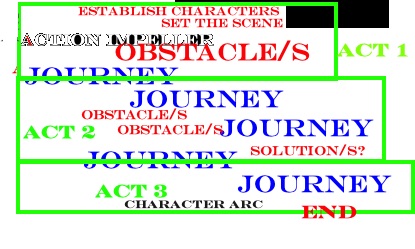
Short stories should, ideally, be in 3 acts. The simplest way of describing them is Beginning Middle and End, obviously! And if you like, the Bend. The unexpected event or person. This can happen anywhere.
Here is an outline:
If the plot is character-driven – you’ve put them in a situation, placed the obstacles, brought in challenges and they figure out what to do and where to go- as a result they’ll make their own line-of beauty. And therefore decide on the conclusion! Your job is to put a brake on your natural self-indulgent desire to decorate bits and throw in useless diversions along the way.
Writers are the most self indulgent creatures ever to walk the planet, except for Donald Trump. That’s because we live in our dreams. As Gods we create characters who, believe me take life. If yours don’t take life you’re crap. Then we put them through heaven and hell. Or, if you’re character-driven rather than plot driven, they put us through heaven and hell and we never really know where the journey’s going. I’ve written extensively on this in my previous blogs.
In this blog, however, I’m concentrating on PLOT-DRIVEN SHORT STORIES.
ACT 1: Beginning
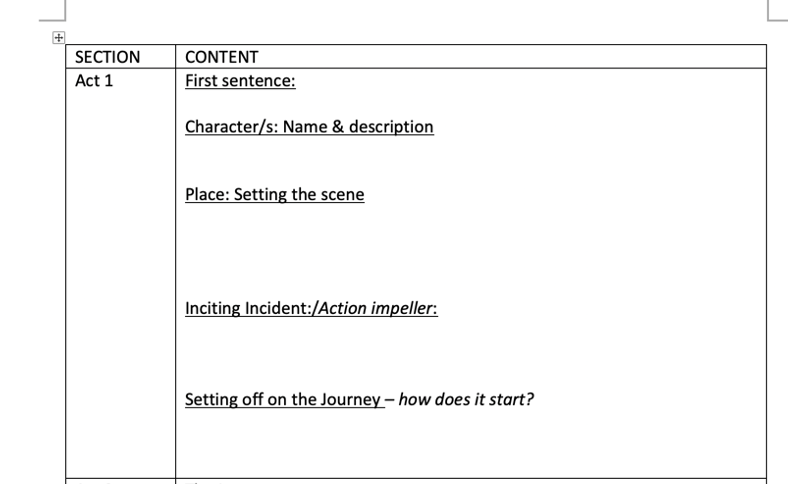
This is the starting point, this is the spark, the idea, the result of that wonderful ‘what if’ moment. See my article on Getting Ideas, if you find it hard setting off on the journey. http://jonelkon.com/no-idea/ Here you set IDEA, CHARACTERS and JOURNEY.
In Act 1, we set off the IDEA whether whole or part (called ‘inciting Incident’ by Snyder and other scriptwriting gurus, and the ‘Action Impeller’ by others)’. This could be an event, an incident, anything good, powerful, bizarre even. Your idea might actually be the end of the journey, or its purpose,
Here we meet the main character, or characters. Here we SET THE SCENE and LAUNCH THE JOURNEY.
See my story ‘Victory for Vittorio’. Act 1 is pretty long. Setting the Scene, meeting the Main Characters. Can you say where Act 1 ends? The ‘inciting incident’ is actually in Act 2! But, as I said, I hate conforming to rules. Here http://jonelkon.com/a-short-story-from-the-ragazzo-a-novel-in-progress/
And critically, this is where the reader may or may not decide to proceed on the journey. Make them! Intrigue, annoy, entrance the reader. S/he must be thinking, wtf happens next! How on Earth are these characters/ this character going to do that>? Survive that? Complete this?
MAKE A TABLE on Word or Excel or draw it out by hand. Firstly:
Act 2: MIDDLE or muddle?
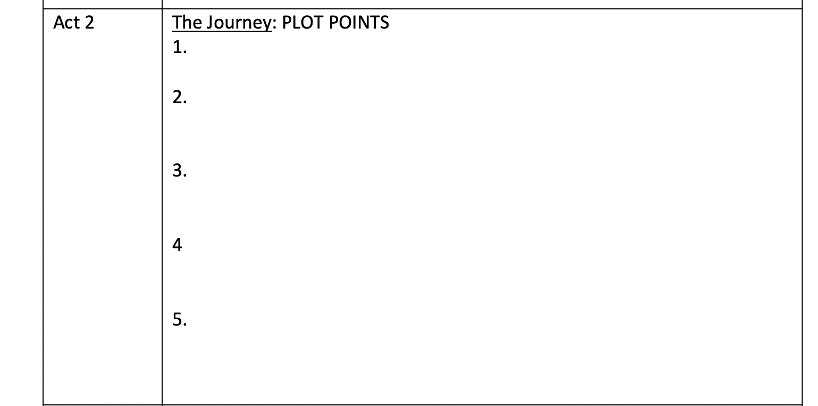
Tell the STORY. The protagonist (Hero/heroine) sets out. Describe the journey. And here, we usually meet the OBSTACLES. You may well have mentioned them in Act 1 as a possibility. The Protagonist needs to face and fight them. Not necessarily overcome them, especially if it’s just one obstacle, say, the baddie, or the Church, or the weather. See my story Victory for Vittorio. http://jonelkon.com/a-short-story-from-the-ragazzo-a-novel-in-progress/ Can you identify where Act 2 starts?
This is the part of the story that can be a swamp.This is where you, the writer, can get lost, can be diverted, can be befuddled by tangents or start to self-indulge to the limit. I am often guilty of these failings. In my other blogs on writing, I have emphasized the importance of editing. I’ll get back to that subject at the end.
Just tell the story! Your protagonist either drives it forward or is driven forward by events. That’s why it’s important that you show how your character reacts or actually grows through the events, without putting in extraneous detail. Yes I know! Difficult. In ‘Victory…’ Vittorio starts looking like a bit of a selfish asshole. Then, in the middle where we get the inciting incident, he seems to change. At the end, we gain respect for him because he has acted according to the desire to save his son. At the beginning, possibly amoral. By the end, a good father who gives up absolutely everything for his son.
We call this the character arc. The extent to which your character changes and/or develops or is destroyed, depends on the events and obstacles. And how s/he overcomes them! Or reacts to them. Or is destroyed by them. See how Vittorio reacts to the obstacles?
Victory for Vittorio is an extract from a novel in progress, so it’s more laid back than a Short Story should be. Look carefully through Act 2: What could be cut, without affecting the narrative?
Fill it in:
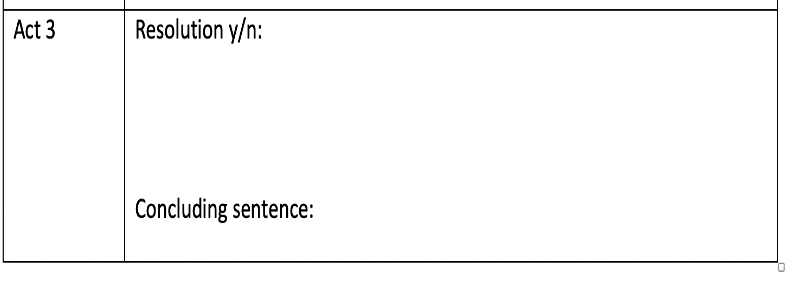
Act 3: Conclusion?
Or resolution. Of course, there may be no resolution, if we are left with a cliffhanger. There may even be a final obstacle to mess with our heads! Many writers (including me) like to end a Short Story or a novel with a fantastic last line which changes everything. I do enjoy these stories, even when it’s a little artificial.
The conclusion to ‘Victory’ is rather neat and tidy, but in order to show the relevance to the plot of the novel, the last sentence tells us he is actually one of the important characters in the book.
Everything sorted, everyone happy. Unless, of course, it isn’t sorted and oops, protagonist falls in front of a train. (I used that in one of my Underground stories) The main thing about the conclusion is that often, it’s not.
REMEMBER to include CHARACTER ARC if the story needs it.
The TABLE is your GUIDE and helper in writing your Short Story. Frankly, you may never need it. But it’s a great exercise to use it once or twice, embed it into your subconscious so that it guides you in future. Remember, only if you know the rules can you break them. I want you to be able to do that.
You know what I’m going to say next, if you know me.
NOW Kill your Children – a horrible image and way to put it, forgive me.I mean
EDIT THE HELL OUT OF IT go back through with a tooth comb. Cut out anything extraneous, even if it’s beautiful. Fix spg. Cut out or amend cliche. Slice out repetition. Make sure there is a clear Line of Beauty to the plot. That it doesn’t go on unnecessary diversions which do not contribute to plot.
If I were to do that with his blog, for example (I don’t really have time. I’m about to go out of my monk’s cell for the first time in 14 weeks. If I return with a virus, cheers dears.) I could EASILY cut it down by HALF. Maybe I’ll do that, and repost it as LINE OF BEAUTY – EDITED. Soon. Of course the last few sentences would go.
Now do this with a story you have written. I’m telling you, you can cut it by 10 – 30% and make it sparkle! Reveal the inner light by cutting out extraneous darkness. That’s why writing Megasagas (stories limited to 100 words) is so good for you. Cut to the quick.
I hope you found this blog useful! If so, I’ll do one on character-driven stories. My favourite.
Now remember to JOIN the FACEBOOK GROUP https://www.facebook.com/groups/940905559677381/?source_id=1780996938782537
Here you can post stories, comment on other people’s stories and poems, or just enjoy a good read.
READ AND STUDY Parts 1- 6 of this writer’s guide. You’ll find them in the blog. One day I will sort them all under one heading. Perhaps I did that yesterday (I sure tried!)
Email me with any queries or comment below.
And keep an eye on my blog, on Facebook and Twitter as Jon Elkon Writer.
Remember, I love you all.