Author: Jon Elkon

  • THE CLARKSON DEFECT –

    THE CLARKSON DEFECT –

    How Jeremy Clarkson makes a fool of himself and his readers!

    It’s not just about Greta. Look, we have all been highly impressed by the fact that a sixteen-year old Swedish girl felt so strongly about the Climate Crisis that she decided to make a stand. And her voice has been heard all around the world, she has addressed the United Nations, she has made a plea for the future. You know all this.

    https://www.theguardian.com/environment/video/2019/sep/23/greta-thunberg-to-world-leaders-how-dare-you-you-have-stolen-my-dreams-and-my-childhood-video

    But type Greta Thunberg into Google, as I have just done, and you will see several horrible right-wing Denier reactions. We are facing the massed ranks of Big Oil’s paid Deniers. All the polluters have a vested interest in continuing to make massive profits, which means they have a vested interest in destroying the climate. And all life on Earth, as most scientists agree. And so the real nastiness in some segments of society comes out. The violent, dangerous extreme right wing identify the fight against Climate Change as somehow a liberal, globalist, Soros-funded battle. For example, a Denier has made a graphic of Greta as a puppet, being manipulated by a Soros-like figure. In the Daily Mail, you can read about Jeremy Clarkson calling Greta a “spoiled brat”. I will not copy the link for you, I don’t want to promote this idiot. Or the Daily Mail.

    Mind you, Metro picked up on it and I don’t mind mentioning them. In the Metro Report Clarkson says “…..the  planet is heating up and something needs to be done before we are all faced with an ‘unimaginable refugee crisis’, the 16-year-old should perhaps ‘get back to school as quickly as possible and work hard in your science lectures’. ‘Because science is what will solve the problem eventually. Not scowling and having screaming ab-dabs every five minutes. Many thousands of people who you had the temerity to blame this week are trying to do exactly what you want,’ he concluded. ‘So be a good girl, shut up and let them get on with it.’”

    Read more: https://metro.co.uk/2019/09/28/jeremy-clarkson-brands-greta-thunberg-spoilt-brat-shut-get-back-school-10823793/?ito=cbshare

    Twitter: https://twitter.com/MetroUK | Facebook: https://www.facebook.com/MetroUK/ Engage!

    The fool. So he, unaware of the science, unlike Greta, he thinks the biggest problem likely to be caused by the Climate Crisis is an increase in refugees. Direct appeal, therefore, to right wing racist paranoia. He doesn’t appear to care about flooding, forest fires, tornadoes, possibly millions of deaths. Could his contempt for this person trying to keep our planet habitable be anything to do with his addiction to gas guzzling?

    Read the appalling ignorant responses to the Clarkson Defect in the Sun.

    https://www.thesun.co.uk/news/10022396/greta-thunberg-meltdown-wont-help-world/

    Stuff like this:

    Do Deniers have children? Grandchildren?

    Am I suggesting that Clarkson is in the pay of Exxon Mobil or others with a vested interest in planet destruction? Hell no.  But when you remember that his fame and income are derived from promoting gas guzzling vehicles, no-one can deny that he has a vested interest in undermining any attempts to limit the use of petrol, oil or diesel.

    Hints on How to Deal with Deniers Online

    Here’s the Elkon kit for Denier- disposal. ALWAYS challenge! For the sake of people reading the interchange, who may be on the fence.

    1. Ask who pays them – make the point that most deniers online are paid by Big Oil or Big other Polluter OR are being fooled/conned by them;
    2. Mention “Children” and “grandchildren” and ask if they have any, and say “they will never forgive you”
    3. Use “science” in your reply
    4. Then block them.

    Declaring an Interest

    Here I must confess that I own a gas-guzzling petrol-driven vehicle. The engine is 1.6 litre. Shame on me! But in my defence, I hardly ever use it. Caroline Russell, of the Green Party in the London Assembly, said in a meeting we had with her “KEEP your gas guzzler for now. We don’t yet understand the impact battery vehicles have on the environment – their manufacture, sourcing the raw materials, using the power from the grid, recycling when they die. Just don’t use it!” So, hello to buses, trains, my beloved bicycle. I have been a petrolhead (shame on me) for years! But I have reformed, step-by step. First, I sold my Alfa Spyder and bought a BMW 1 series – Diesel, because I was told that would be better for the Environment, like so many others. Then, when I heard the dreadful news about particulates caused by Diesel, I sold that and bought a 1.6 Peugeot with good fuel economy.

    So a gradual improvement. There’s a way to go! Like so many others, I cut down on my carbon footprint a little every day.

    But that’s Not Enough!

    We face a Climate Crisis. A few years ago, I joined the Green Party. A merry band of like-minded warriors. To my surprise, while there are certainly a few tree-huggers and scandals and socks wearers, the profile of the Greens is changing radically. Now that their message – the message they have been promoting for almost 50 years – has become mainstream, they are gradually becoming the Political Wing of XR – Extinction Rebellion.

    Proof that the GPs message has become mainstream is that all the other parties are assiduously putting on Green clothes. The Tories, with their utterly insincere commitment to “Carbon Neutral by 2050”; Labour, with their determination to beat the Tories at everything except cricket, “Carbon Neutral by 2030”. The LibDems “Carbon Neutral by any date you bloody want as long as you vote for us”. And the Brexit Party “Soros!”

    And so I am standing for the Local Council by-election in Heston West. The by-election hasn’t been declared yet, so you heard it here first. Sadly the Councillor died recently so there is a vacancy. As a result of Green Party pressure, Hounslow Council has declared a Climate Emergency and they are developing a plan to tackle it. What’s needed is some Green Councillors to keep their nose to the grindstone and prevent backsliding.

    So much to say on all that, but I’ll reserve it for next week’s blog.

    Stay sane! Remember I love you.
  • MEGASAGA NEWS – WINNER!

    At last I can announce – the WINNER!

    Or rather, I can’t. The BEST MEGASAGA was undoubtedly

    BLOW

    by Mr GL, who only wants to be known as Grigor. Those of you who read my blogs regularly will recognise the name, as Grigor frequently comments on my posts. Let me assure you, the judges’ decision is based entirely on the quality of the writing, rather than the loyalty (?) of one of my readers. Gregor’s request is that I publish no details about him. I am allowed to say he is 40, lives in South Africa, and has a great sense of humour.

    Judges’s comments:

    “I had to read the story several times to appreciate its quality. The reader is successfully diverted from the narrative. There is, in fact, no narrative. Simply, the title and the ending, with a filling in-between. Brilliant. Almost an inversion of the form.” JD

    “The writer’s descriptions alone are worth the prize. He succeeds in delineating characters so clearly, in just a few words….” PL

    “I hated it. I feel as if I was tricked. Definite winner.” JE

    So here it is. See what you think:


    Blow 

    The smell of humans bewilders me. For so long all I had was the hospital smells, disinfectant, misery and fart. 

    Emerging from my chrysalis of pain, nothing’s changed. Thank goodness the operation is done! Now home! The tube train departs seconds before I arrive at the platform. This train’s destination is wrong, necessitating an irksome change. The passengers happily slot into their stereotypes, from the hoop-earringed fashionista with torn knees to the primary school headteacher in her sensible coat reading Adrian Mole. 

    Nearly there. Perhaps the man with his shaking hands pouring with sweat opposite me is about to


    CONGRATULATIONS Grigor! Your £100 is winging its way to you.

    A message from me: To be honest there were very few entries, probably as a result of the £5.00 entity fee and I did not recoup my costs. Not important! Just saying. Therefore the next one, the fee will be much lower. My objective is to encourage new young writers, to help as much as I can not just with developing the craft, but with getting a good following.

    ALL entrants have been emailed with detailed responses and critiques. Please do not be offended if you think me or the judge harsh, but it is important to stick to the rules of the format. While some errors of spelling, grammar and punctuation are inevitable, do check and edit your work before submission next time. But don’t let that put you off submitting! If there’s real quality in your vision, I’m happy to help edit your work. 

    LOVE to you all!


  • Intimate Mortality

    The next time I speak to you I may be dead. I may not be. At my age, I may be dead any time. I often think I died years ago, this is just a dream.

    It may appear to be a fairly one-way conversation, but it will be a long one. About 229 pages. My farewell to you is The Ragazzo, my latest and possibly last novel- if my literary executors get their act together and get it published. When you read it, you are speaking with me.

    The Ragazzo is the ultimate Outsider. Castrated for a bet, Guido has to make his way in the world of Opera over the bodies of anyone who stands in his way.

    Guido is me, although I haven’t killed anyone – as far as I know. And  every Outsider looking out of his or her eyes, from the chaotic place where he lives inside his skull (I’m going to use the masculine pronoun, because I’m talking about me), through the clouds of self through which he peers, tries to identify recognisable landmarks of comfort. Sometimes they turn out to be mirrors and it’s not easy to see through those. Sometimes they are the words one craves for sustenance, essential for continuance, for survival.

    There to answer the question, what do they think about me.

    (Are you with me yet?)

    I was an outsider from the moment mother put me through the windscreen of her Renault, when I was five. I don’t know why she attacked the brakes so violently, her high heels slipping off the brake pedal, the front of the little car doing an elegant impression of cardboard crushed up against the fist of a giant. The scar I bear across my eyebrow faces me now in the mirror. So hard to see through.

    It was as if another world came into mine, intruded with that shard of glass into my skull, invaded there, splintered the me I would have been, lay where no-one else could ever reach it. And since then I believe, I have understood that I am, have always been and will always be an Outsider.

    I grew up outside. At school the boys knew, so they banded together to exclude me with words carefully chosen to make me take refuge in solitude inside my skull, where I was safe. Which I populated with words, many written by great writers, all of whom were whispering or shouting or screaming “HELLO IN THERE – come into my castle!  I will populate your brain with my creatures for a while, then I will leave you feeling more alone than ever, the decaying corpses of my creations mouldering in your mind until they are replaced with other populations, others screaming HELLO IN THERE! CARE ABOUT ME now!” And the sad and violent truth kept coming back, the knowledge that no-one could ever really understand.

    No-one can ever really understand.

    Listen to me: You are alone.

    Listen to me some more: So are you.

    Listen to me again and again. Hey, you over there! Listen: So are you.

    Alone.

    When you and Mr Death have to merge (he is male), you will know exactly what I mean.

    And so am I.

    (Are you with me yet?)

    (Do you get it?)

    (Yet?)

    (Do I have to make it plain?)


    (We’re all alone. Because we are all outsiders. Living here in our skulls which we think are barriers. Which we think.

    We are alone together)


  • VILLAINS!… and a PRIZE at the end!

    VILLAINS!… and a PRIZE at the end!

    Donald Trump! Boris Johnson! Jeremy Corbyn! Bolsonaro! Erdogan! Putin! The modern day baddies, at least to half the world. But to the other half? To their mothers? In this tutorial, we will explore how to develop a convincing villain in fiction, who is at least as believable as the real ones.

    EXERCISE 1

    Marie has run away from home, and is in hiding in a barn. She is 15 years old, has just discovered she is pregnant from the only time she has ever had sex. Her parents are religious fundamentalists.

    Who is the villain?

    Several possibilities.

    The man who made her pregnant? Let’s think about him. Which is more believable:

    1. A fifteen-year old boy who is in love with her;
    2. Her 30 year-old teacher who seduced her in the classroom
    3. Her father.

    WHY ARE YOU ASSUMING THAT THE MAN WHO MADE HER PREGNANT IS A VILLAIN?


    Levels of Hatred

    Which of these would the reader hate most? Obviously we all have a Romeo-and Juliet- induced sympathy, if it’s 1. Aww, young lovers. How sweet.

    If it’s 2, our ire is  immediately aroused. The shit. He took advantage of his position of power to seduce a young girl. Under age!

    If it’s 3, another layer is added to our fury. Not only did he take advantage of his position of power, he used love as a weapon to fulfil his incestuous desires.

    Now, what do we want to happen to each one of these?

    Your answers please.

    Do you realise that we, the readers, want revenge? The level and type of revenge escalates from 1 – 3, yes? Although as an ex teacher I would devise special tortures for number 2. Plot lines!

    What if the villain is the girl? Why should we immediately assume she needs protection? Could you develop the scenario? Suggestion: She’s utterly without conscience or morals, hates her loving, religious parents, seduces a young man to get revenge and drive them crazy…runs away to give them nightmares…

    Is there any way you could find a scenario which would excuse number 2 and number 3? Maybe number 2, if combined with the girl-as villain scenario above, but nothing could excuse number 3, right?

    Personally, I will always see the girl in this situation as the victim – whether of her parents, upbringing or the men who prey on her. I have no sympathy with them.


    PSYCHOPATHS, NARCISSISTS AND SOCIOPATHS

    Welcome to the most popular trope of the 90’s all the way to the nownies.  A XPD villain operates  entirely without conscience, is incapable of empathy, is immensely calculating and therefore terrifying to those of us who are part of the approximately 80% of people who are not P, or N, or SPD. (Some experts put the number of people with PPD – Psychopathic Personality Disorder – at 25% of the population. They say that all the captains of industry, education, medicine and of course government are undiagnosed PPDs. I think they have conflated NPDs with PPDs. NPD – Narcissistic Personality Disorder. Or SPD – Sociopathic Personality Disorder…for detail, see https://www.psychologytoday.com/gb/blog/mindmelding/201301/what-is-psychopath-0

    So yes, of course your villain could be totally BAD. BAD through and through, owing to a personality disorder which you, the writer have thoroughly researched – and used as a basis for the character’s actions and an excuse for not really thinking about emotional motivations. Obviously you do not go into any exposition or explanations, and certainly do not (unless called for in the plot) use any of the technical psychological terms. This gives you licence to have the villain commit utterly horrible acts without having to really explain them, except in purely mechanistic technical terms. The villain then becomes a mere plot device to allow you to fully explore your protagonist’s responses to the obstacles and the journey the villain has imposed on him or her.

    EXERCISE 2

    a) Which of the FOUR villains (if you accept that in Marie’s story, any of the 4 could be a villain) is most likely to be a psychopath, sociopath or narcissist? Why? (One paragraph)

    b) Pick a villain in Game of Thrones who is a member of one of the tribes described above. Explain why you have made your diagnosis. See?

    The lazy writer’s Paint your own Villain by Numbers. Or rather, letters.

    EXERCISE 3

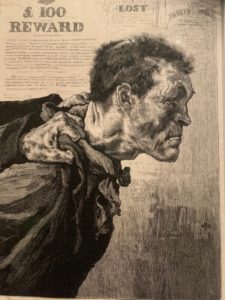
    Study the stereotypical villain above, (which I photographed at the recent brilliant Van Gogh exhibition at the Tate. I forget if it’s by Van Gogh or a contemporary – anyone know?). Explain: WHY did he become a villain? IF he did?

    THE UNLETTERED VILLAIN – MOTIVATION!

    If your villain is not PPD NPD or SPD, you’re going to really have to explore MOTIVES. In the screenwriting game (I am writing a screenplay at the moment, so I am a little obsessed with film) your villain has to be a 360 degree character, whose physical appearance either complements or entirely contradicts his/her character. Marvel villains are usually sheer black-and white, although the X-Men series has far more subtle tones. The villains in the DC Universe are much, much more obvious. See my previous blog: Character. http://jonelkon.com/part-5-who-creating-believable-characters/

    Here’s a very good blog on movie villains https://filmschoolrejects.com/villain-motivations/ and their motivations.

    As a novelist, you have a very different job. You have a fantastic advantage over the writer of a villain depicted on screen – you can, should you wish, share  his or her thoughts with your reader. Yes I know, movies have v/o – voice over. But it’s really terribly unfashionable these days. and in the old cliche, adapted for this purpose, the pictures in the mind of the reader are so much better than the pictures on a screen.

    So what sort of motives turn a person bad?  Here’s a partial list:

    Let’s start with the seven deadly sins! (Links to Wiki)    pride, greed, lust, envy, gluttony, wrath and sloth,

    But there are more, of course!

    A nasty childhood

    Injury, mental or physical

    Perceived injury mental or physical

    Emotional instability

    until we reach the most common: Revenge.

    EXERCISE 4:

    Pick one of the characters in our saga. Can you ascribe one or more of the motivations above to that character? Write a paragraph saying which, and why!


    SAVE THE CAT

    As I explained in a previous blog, every human character has to be human! So always show that even a villain has a human side – unless he or she is XPD! (Do you know why people whose partners are XPD stay with them? Despite being controlled, stalked, maybe even beaten? Listen as they say, tears in their eyes – “Only I know the REAL – insert name here – I’ve seen his/her weaker side!”) So always give your villain a soft side; or a reason for being nasty. Not an excuse! Because otherwise you haven’t created a villain, you’ve made a cardboard cutout. See the excellent https://www.amazon.co.uk/Save-Cat-Only-Screenwriting-Youll/dp/1932907009 Gary Snyder’s Save the Cat.

    That’s the secret, right there. A villain who could not be admired and loved by someone, if only his or her mother, is not a believable character. Your reader has to have either a trace of sympathy, our complete contempt. The most powerful villains (Heathcliff!) have a side one can sympathise with, or even love.

    In my books Umfaan’s Heroes and Laszlo’s Millions, the Brigadier is a perfect example! My latest novel (in progress. Working title: Ragazzo!) has a hero who is a villain. It’s not his fault!

    If you’ve got it, you may as well just go ahead and write your book or story or film…

    SUMMARY and CHECKLIST

    1. Decide: PD or No PD? If no –
    2. Motive/s: Pick from list above
    3. Human side: Find soft side
    4. Decide on final fate!
    5. Fit into plot….


    FINAL EXERCISE

    Using the Marie story above, write a Short Story of around 2,000 words based on all the elements you’ve developed so far.

    There will be a SET OF THREE OF MY SIGNED AND DEDICATED NOVELS for the best one submitted to jonelkon3@gmail.com – use subject Marie


    NEXT TIME

    How to write SEX! The next blog in my monthly series will adequate explain why I’ve never quite succeeded at writing good sex! ….could it be because I never had any good sex? Naaaaaah!

    Remember: I am always happy to give advice and help, especially to new writers. Free, natch!


  • Part 5: WHO? Creating believable CHARACTERS!

    Part 5: WHO? Creating believable CHARACTERS!

    Exercise:

    Please have a good look at him or her.

    Yes, I mean the person in nearest proximity to you right now.

    If there’s no-one near you right now, go to the park. Hop on a bus or tube. Sit at a bus stop. Look. Pick a person to look at. Are you looking?

    Describe: Age range. With most people, fairly easy within at least ten years. Sex or gender: with most people, fairly obvious. Their socio-economic group, income, class – a reasonable estimate can be made from their garments.  Fine. Can you do that? The chances are you will be somewhere near the facts, especially if you are a dedicated people-watcher.

    If you are NOT a dedicated people watcher, please crawl into the ball of your own ego and give up the idea of ever being a writer! Because the main quality of the good writer – alongside a fair facility with language – is the ability to observe. The world is, after all, a movie for our benefit.

    You looked, but did you see? Looking is just the start! Because even if you can draw fair conclusions under the headings above, you know next-to NOTHING about the person you’ve been observing.

    Oh yeh? Then answer these questions:

    What music do they listen to?

    What’s their favourite food?

    What do they do for sex?

    What do they want from a lover?

    Can you know their family background?

    What car do they drive?

    What do they aspire to?

    Who are their heroes?

    What illnesses do they have/will they have? What do they do (if anything) for fitness?

    What makes them emotional?

    What makes them cry?
    -What makes them laugh?

    What are their hobbies/interests?

    What is their opinion of themselves?

    WHAT WOULD THEY DO IF:………………………

    That’s the main WHATLIST. The ones I can think of here in the Hot House Cafe over my veggie breakfast. (with a couple of other w’s).

    But even more important is the WHY LIST. Add “WHY” to each of the questions above and you are beginning to know the person.

    As a writer of Fiction, your job is to create characters with a FULL WHATLIST and a FULL WHYLIST.

    So yes, you cannot fill in the Whatlist and the Whylist for that delightful creature sitting across the aisle from you. But you write Fiction, so it’s your job to fill both lists with utterly believable lies.

    Does this mean you need to include all the Ws in the story or novel? HELL NO. But if you don’t know the answers, at least for your main characters, how the hell can you predict how they will react when they walk in on their mother having sex with their uncle, or when they lose a leg in a tram accident or when they are accused of child abuse?

    With minor characters, the full list is not as important but you know what? I love to be able to write the backstory for each and every character, as you will see in Laszlo’s Millions and even more in my forthcoming novel, the Ragazzo.

    If you create full, rounded, 360 degree multidimensional characters, they come to life. Believe me! You and your keyboard are the god who manufactures people and their worlds.

    Inspiration for Characters

    So no-one ever invents a character from nothing. (Challenge!). Every character in fiction is inspired, or sparked, or dictated by someone real. This is WHY the writer is a dedicated people-watcher. But you have to be more than that.

    You have to be a PEOPLE COLLECTOR!

    You and your notebook are the equivalent of the butterfly-hunter with her net. Everybody is individual, precious, special. Every person in the real world has a full Whatlist and a full Whylist. (See my previous blog for How, When, Which, W, W, W etc). Whatever you can find out – or collect – feeds into your understanding of humans, which can feed into your fiction. Ask questions. Observe. Especially facial expressions. MOTIVATIONS and BACKSTORIES are treasure.

    Your friends and relations are the first people to collect! People you know most about have the most clues to yield to human motivations, types, reactions to events.

    Love People!

    Because the key to any character is (you’ve read this far so you deserve your reward) is not just what they are and why, but therefore –

    WHAT DO THEY FEAR?

    WHY?

    WHAT ARE THEIR WEAKNESSES?

    HOW WOULD YO DESCRIBE THEIR SELF-ESTEEM?

    WHY?

    And, of course, the opposites: What do they hope, why, what are their strengths, why.

    Btw: A little extra madness for you to contemplate: Sometimes I like to decide when their birthday is, and their astrological sign. This helps me to set character, although astrology is probably bullshit. I would never bring it up in a novel unless it was relevant to the plot of course. And I only use it when stuck. Not routinely!

    Another nutty thing I do: do you know what nominative determinism is? The theory that people’s names often send them to appropriate occupations. Dammit I’ve just heard a Food Programme produced by Dan Saladinho. Gardener’s World has a presenter called Bill Sourbutts. I bet you can think of loads of examples. Well, the same often applies to personal characteristics or personality types so I often bury a type within a name. This is nothing new; Dickens did it all the time! Uriah Heep, a snivelling creep. Scrooge – which came first, the name or the type of mean person? Check some of the names in my books or short stories, you’ll see why I mean. I do try not to be too obvious!

    Body types: Bear in mind the basic types – ectomorph, mesomorph and endomorph. Ecto: naturally thin, hyper, they eat lots and never get fat. Meso: if they eat lots, they get fat. Middle! Endo: often overweight and self-indulgent (arguable). LINK the body type to their emotional and intellectual worlds. I’m not telling you how to do that. OBSERVE! COLLECT!

    Intelligence: How people react and respond to events depends on how well they can calculate risk, how emotional they are at the time, how hungry they are, how tired, how randy… so many factors! Remember, IQ is only one measure of one type of intelligence. But always bear in mind your character’s ability to process information. I’m not telling you how to do that. OBSERVE! COLLECT!


    There is no substitute for compassionate insight!

    If you love humans, you will need to understand humans. If you understand real humans, you can give birth to fictional ones. You must inhabit their private worlds, even as you create them. If they are happy, you are happy. If they suffer and you, the writer, don’t weep, then your character is not real.

    The fate of Pieter in Lazlo’s Millions plunged me into absolute misery and guilt for months. Pieter was 360 degrees of a person. Based firmly on someone I know very well, it was easy to define and encompass him with words.

    Make them live! Your characters live, laugh, suffer, love and die at your behest. They will inhabit your world your whole life, and the worlds of your readers. You have the absolute responsibility to make them REAL. (God I hate cardboard 2d stereotypical characters. Avoid stereotypes! Even though some people appear to be stereotypes. Just look inside.)

    (Sheesh. I could write a book on this topic. Perhaps I will. But meanwhile, please pick up and use some of the above in your writing. And always remember, if you would like free help and advice, you only have to email me johnelkon@yahoo.co.uk)

    May good luck – and more important, hard work! – make your writing better every day.

    NEXT TIME: How to WRITE A VILLAIN!

  • WIN £100 FOR 100 WORDS!

    WIN £100 FOR 100 WORDS!

    Welcome to the second great MEGASAGA competition! The entries for the first one were superb, and the winner has enjoyed her £100 prize. (See http://jonelkon.com/the-megasaga-100-goes-to/)


    THE RULES

    (Note: these have been slightly adapted since the first competition – it’s a learning curve!)

    A MEGASAGA is a story of EXACTLY 100 WORDS including the title! As far as possible, there should be beginning, middle and end. To win the writer must evoke a powerful emotion, or describe interesting or unusual events, or people. She/he must show a good command of language and imagery! For examples, read the shortlisted entries for the last competition HERE:

    http://jonelkon.com/megasaga-shortlist-announced/


    The prize is £100!


    Timing

    DEADLINE FOR ENTRIES is the last day of JULY 2019.

    The SHORTLIST will be announced by 14th of AUGUST on jonelkon.com. Get your entries in early!

    The WINNER will be announced on jonelkon.com on the LAST DAY OF AUGUST 2019 and the prize of £100 will be paid out to the best Megasaga writer.

    FEE: Entries will cost £5.00 each.

    Payment: I prefer payments through Paypal made to johnelkon@yahoo.co.uk on submission, OR if you want me to invoice you through Paypal I can do that.

    If you don’t have Paypal, please ask FOR AN ALTERNATIVE METHOD in your email.


    SUBMISSIONS

     Please email your entry to Johnelkon@yahoo.co.uk as an attachment or within the body of the email with the heading MEGASAGA ENTRY

    Confirm in your email that you have paid through Paypal and I will get a notification from Paypal to that effect. I WILL SEND YOU A CONFIRMATION THAT YOUR EMAIL AND PAYMENT HAVE BEEN RECEIVED.


    IF YOU ARE NOT SUCCESSFUL I WOULD BE HAPPY TO GIVE YOU THE JUDGES’ CRITIQUE OF YOUR WORK, so that you will get insights on how to improve your writing. Please request this in your email if you want this (free) service.


    JUDGING

    There are four judges: Myself, a poet, a screenwriter and another author of fiction.

    The judges’ decision is final

    Note: All submissions must be in English and presented double-spaced. Please do not enter into any correspondence until the shortlist is published. Once this has happened, everyone is free to add a comment to the post on the website. And I hope you will!


    GET WRITING! NOW!

  • No Idea?

    No Idea?

    Ideas! Where does a writer of fiction get ideas?

    This is one of the most common questions writers get – in this article I will give you my ideas about ideas. I hope many of these will be eminently practical and useful.

    YOU LIAR YOU!

    As I have written before, a writer of fiction is a professional liar. That’s what the word “fiction” means. So you are going to hit that keyboard with lie after lie, and if you lie well enough you can make money from it. After all, Trump has! But then his motives are far darker than yours.

    Here then is some damn good advice for generating ideas:

    1. Start with the TRUTH and lie about it. 

    My first novel is shamelessly autobiographical. This is true about most authors. Look at this list! Did you know most of these writers started their literary career with their own life story? How many first novels can you name which start with autobiography – or a version of it?

    Here’s the Wiki list:

    https://en.wikipedia.org/wiki/Autobiographical_novel

    You have a great story – your life story! However boring it may seem to you, there are aspects of it, if lied about, which could be fascinating to a stranger. If in doubt pick something TINY. Say, the owner of the local sweetshop in your home town had a wart on his cheek. The sweet shop closed when you were twelve. You were fairly sad about that.

    How boring.

    So fictionalise!: It wasn’t on his cheek. It was on the end of his nose. It continually dripped and grew larger over the years. At first his customers giggled about it but due to the local gossiper (introduce an interesting character, not a cliché!) they began to suspect he was diseased, and eventually stopped buying his sweets. Now the sweet shop owner was a single parent with a young teenage son, a brilliant mathematician who was offered a place at Oxford, but because of the old man’s impoverishment, he would have to become a cashier at Tesco’s…. now write on! Set yourself free from your own story. Take the truth and lie about it!

    Maybe you have had a fascinating life, full of drama, challenge and really funny episodes. If you want to tell your story, fine! Write a memoir. But truth is so often unbelievable, or melodramatic, or not nearly as interesting to another person as it is to you. So take the truth and lie about it! See my first novel.

    The protagonist: In your lies, the protagonist (the person the story is about) can be you, in the first person, or someone totally different. Who is still you. Try changing genders. VERY HARD TO DO. I tried it in my third novel, Sally’s Road.  Critics were very flattering but frankly I don’t think I pulled it off. No pun/s intended. (In my coming novel I do pull it off. Because the protagonist is a castrato. Apologies for the bad joke.) Maybe you are a great winner in your life. Your protagonist could be a winner too. Or a loser, but if you want to sell film rights to Hollywood, he/she must win in the end.

    The plot:

    THE TWO BIGGEST WORDS IN IDEA GENERATION:

    WHAT IF….


    1. “What if” everything!!!

     Some of my best Short Stories started with a simple “What if…”. This one started with “What if Donald Trump is an alien?” http://jonelkon.com/report-from-earth/

    This one: “What if the partner of the girl you have been having an affair with gets you on the back of his motorcycle?” http://jonelkon.com/pillion/

    This one: “What if ‘Tube Surfing’ was a Thing?” – inspired by my stupid habit of seeing how long I could stand unsupported in a tube train. Which inspired: “What if there was a secret society of Tube Surfers?” and then “What if two Narcissistic macho males decided to have a life-or death Tube Surf competition on the Circle Line?” http://jonelkon.com/tube-surf-no-exit/ SO “what ifs” breed. Put “What” and “If” in a brain cell together and they are going to have babies.

    (That one, No Exit, was to be made into a film until London Transport said No Way, it encourages dangerous behavior. How boring.)

    EXERCISE: Can you sum up the “what if” in my stories “Mile High”, http://jonelkon.com/mile-high/

    And “In a Flash”, http://jonelkon.com/in-a-flash-500-words/


    1. EVERYTHING is inspiration!

    Anything and everything can spark ideas. We are surrounded by the everyday. But it’s your job to make the ordinary assume the mantle of the extraordinary. In a new, exciting, amazing way. Take the ordinary. Expand on it. Throw in an interesting character. Make the ordinary start to distort around this character. How is he/she reacting to the ordinary? Preferably, in an unusual or eccentric way, and you have the start of a story.

    For example: there is a thunderstorm. Wow. Now to make it interesting, lie about its intensity, add in an interesting or boring character (possibly yourself), and some others and a bit of What If and you have a story. You see a pair of shoes lying on the sidewalk! (One of my stories was sparked by this experience). Wow….now what…..,

    Which inspires my last idea (for now) as to how to get ideas:


    1. WHO, WHAT, WHEN, WHERE and WHY? Or, why not? Also a dose of HOW.

    Throw those words at your setup. Add What If to each. Be able to set your imagination free to INVENT. You must know the answers to ALL those questions about your plot, character/s EVEN IF THEY ARE NOT IN YOUR STORY. I was once given excellent advice as to how to assume a character when I was on the stage. “You must know what they had for breakfast. And why!”. It wouldn’t be in the script, but for damn sure characters have to be living, breathing, 360 degrees in your brain. They must piss, shit and probably masturbate….but more about CHARACTERS in the next blog!


    I hope these words have been of some help, dear writers. Please feel free to email me with examples, queries, or in response to the exercises in this blog.

    NOW

    1. SET YOUR IMAGINATION FREE! Your dreams are rich and rare and colourful, so that proves you could be a lovely writer. Your dreams are also great sources of inspiration! Harness them. Craft them. Develop your vocabulary by wide reading. Continually write. Have a notebook by you at all times.

    WRITE, WRITE and WRITE!

    …let me know how you get on….jonelkon3@gmail.com or post a comment below.

    Do read my Tips for Writers Parts 1 2 and 3! They’re right here, in the panel on your right.


  • TIPS FOR NEW WRITERS Part 3:

    TIPS FOR NEW WRITERS Part 3:

    SECRETS, LIES AND SURPRISE!

    And AIDA!….

    What are the basics of a good joke?

    Start with the ordinary. Then surprise! And people laugh because the unexpected snuck up on them like a sudden feather up the nose.

    Here are some of the worst jokes on the internet:  http://justsomething.co/18-of-the-funniest-jokes-ever-10-is-gold/

    Almost every one of them relies on wordplay. An unexpected rendering of a well-known word or phrase. In other words, a dad joke. Or a dud joke. See? I just made one! But in writing fiction, bad wordplay is horrible. Avoid! But good mind play makes all the difference.

    It’s easy being ordinary. Extraordinary requires balls. Especially if you’re a woman.

    (Is that bad wordplay? Or just put there to annoy and shock? Do not misinterpret the above. I’m not going into why the last  paragraph is not sexist. It just isn’t.)

    Extraordinary means avoiding cliche of course – in my previous tutorial I explained how you can demolish the components of a cliche to create better images. In this article I am going to concentrate on the hunt for refreshment – waking up language to surprise and delight the reader with the deliciously different.

    The best place to hit them with the unexpected is obviously the first line of a story or novel. It took me ages to come up with killer first lines, long  after the novel was completed. I am happy with my openers of my first two. Umfaan’s Heroes’ : “ Hallo. My name is Thomas Bloch. I am lying on a bed in a military hospital. This is 1967. The body I am wearing is full of holes, dents, cuts and bruises….”

    Full of surprises and mysteries.  The reader’s question is “why?” What does he mean by “the body I am wearing”?  And so the reader’s duty is to find out. Hence, read on.

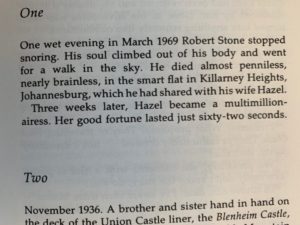
    In Laszlo’s Millions, I used a whole paragraph to get the reader to invest in the story.

    So like a good joke, I end the paragraph with a surprise, that is also a teaser. Then, sudden surprising backstory.

    The great secret of good advertising – and getting a potential reader to buy your book  –  is also the name of a grand opera: AIDA. An acronym, of course.

    Attention- get it with jacket design, blurbs, reviews, title.

    Interest: arouse interest with your first lines

    Desire: make the reader want to know what comes next. With a teaser or a great character or an amazing event.

    Action: read on! Read to the end!

    So you, dear writer, had better earn the honour of a reader reading your whole damn book and loving it.

    Sing! Skip Ad! Skip Ad!  https://www.youtube.com/watch?v=l3w4I-KElxQ 

    My novel in production (which may be called ‘Ragazzo’ or ‘Castrato’ or possibly, ‘Opera’, whichever delights me more) begins with “     “ (Not telling you yet. That first paragraph is still being crafted.)

    However good the first line, if the rest’s crap, you have created a mere fart. Your mum or boy/girlfriend will notice it for a bit, snarl, blame you for polluting the family name, and then forget it ever happened. All it will ever leave behind is the trace of a sneer.

    So what is the difference between farting and a good shit?

    CANCEL THE ABOVE!

    A perfect example of a writer striving so hard for originality, he reverts to shock. Toilet images. Boo.

    Surprise! Watch Killing Eve Season 2 Episode 1. The scenes are like small islands in a bloody sea which the viewer visits in sequence. Attached to each island are sweet seconds of surprise: In a mortuary, with a gruesome body in the foreground, Eve suddenly says “I want a hamburger” to which the response (I think it was Carolyn) is, “It’s the formalin. It makes you crave meat.” So they order burgers and eat them while discussing the cause of death. The burgers have no relevance to the plot whatsoever.

    There are many more, this episode is the perfect example of what I mean.

    As to writers, Kurt Vonnegut is a master of this technique.

    Exercise: watch an episode of a successful Netflix or Amazon series.  Choose something more or less in the Black Humour genre. Black Mirror is perfect. OR Killing Eve, of course. Identify an island, and explain how SURPRISE is used.

    Afterthoughts:

    1. Do not overuse surprise or it’s no longer surprising.
    2. Avoid dad jokes
    3. Be playful! But never cause teeth to grind.
    4. Be aware of GENRE, tone, pace and style. Getting this right is critical.

    The scriptwriter I’m working with on a series says, “Every scene must have conflict in it.” NEXT TIME: How to use CONFLICT and contrast.

    KEEP WRITING! Remember, I am happy to read your exercises and make comments, either use the comment thread below or email me at jonelkon3@gmail.com.

    p.s: Secret exercise: There is evidence that I don’t always follow my own rules in the article above. Can you find it?

  • Writers write! Feedback on A WRITING EXERCISE

    Writers write! Feedback on A WRITING EXERCISE

    A little while ago I dropped a fantasy/dystopian/horror plot idea on to Facebook and this website, see http://jonelkon.com/a-writing-exercise-for-you/and just wanted to share this one from Grigor, which I think is pretty gruelling, with my comments.  I’ll paste it in at the end of this blog. Gregor has given me permission to use it as an example. Thanks for that!

    What do others think?

    Other writers who have submitted, I have answered you individually with ideas for improvement or general points on style etc, but herewith a few general points:

    1. Exposition can be an enemy, unless it’s done in an incredibly original way. In my new novel, I have to inform the reader about how castration plays a major part in the history of Opera. Yes, really! So hard to do, so I understand how some of you resorted to explanations. Have a look at how Grigor did it. Did he succeed?
    2. Humour: look (Abbie!) it’s very hard to present this kind of plot humorously. As I’ve said to you, you did it but be very careful of used tropes…
    3. At the other end of the spectrum: horror. It is hard to be bleak without exhausting the reader. Perhaps the tone of Grigor’s is what I like.
    4. Viewpoint character: always decide whose story this is, and who’s telling it. If a detached narrator – who is he or she? Is he/she omniscient? You don’t have to say who she/he is, as long as you know.
    5. TONE!
    6. On the subject of cliches (no names!) – people often use cliches in speech, so to some extent I forgive you. But there is no excuse for “he was as sick a a parrot” (yes, really.) Sometimes I take a well-worn cliche (like that one – i.e a ‘well-worn cliche’) dust it, polish it and change it. You could Monty-Python it, for example, by saying ‘as sick as a dead parrot’ Or ‘sicker than a parrot under a steam roller’ but that works better in humorous writing.
    7. What else: description: showing off! Adjectives and adjectives upon adjectives. Not trendy! Better to look at your most beloved sentences and give them a snip, without castrating them. Here’s a writer’s cliche for you: “Be ready to kill your babies” – i.e, sometimes a sentence or a description or even a character can easily be culled, leaving the whole story much better for it. (You know who I’m referring to dear fellow.)

    If YOU submitted a story and you are prepared to let me pull it apart here, in public, please let me know. (email is best).

    So here then, not presented as the ideal but simply as a version I liked, is Grigor’s story. My comments are in BOLD.

    A DEATH

    Interesting Title. Teasing, but could he have used something more interesting?

    When he opened his eyes, he knew he was no longer here. The evidence was all around him. The shattered remains of his Piper Cub airplane, clinging to the side of the cliff as if crucified. And Blo was just below the wreck on a narrow ledge, with aircraft fuel spurting down onto him.

    Great setup! Very visual and original. I love “as if crucified”

    A man ambled along a path at the base of the hill toward him, whistling. He was about twenty five, gaunt for his age, almost cocky, walking with the insouciant confidence of a young man who knows precisely where he is going.

    “Who knows precisely…etc. Could he have used a more original description?

    Thank God, thought Blo. “Hey there! Help! Help” he shouted

    “Hello up there!” The man looked up, saw him and winked. “I say,” he said, “got yourself in a bit of a mess haven’t you?”

    I like the implied tone of the man at the foot of the cliff. I hear an exaggerated posh accent. Good fun

    “A bit of a mess! Help me! The plane’s about to blow!”

    Just then the plane blew up. A fireball roared out from the fuel tank, a horizontal volcano erupting outward.

    Shock and surprise! Love this. Can a fireball erupt outward?

    Everything disappeared. When Blo opened his eyes he was lying at the foot of the cliff. The Man stood over him, arms akimbo, a huge grin splashing across his face as if  he’s suddenly understood the joke.

    Good stuff! We may realise Blo has died, and ‘getting the joke’ is a wry and ambiguous phrase here.

    “Welcome!” the Man said,  “Conscious now are we?”

    “I don’t know….” Blo said, inspecting himself for injuries. “I don’t believe it…” He inspected himself for injuries. Then he stood, shakily and looked up at the still-burning plane.

    “I think we’d better get you out of here,” the man said, taking his arm. “It looks to me as if we may just be about to get rained on by flaming aircraft.”

    Pace: We need to move the action on rapidly, and Grigor tackles this well by changing the scene.

    Rapidly the two men ran down the road, and none too soon, as what was left of the Piper Cub rained down onto the ground in showers of flaming metal and fuel.

    “Where am I?” Blo asked. “Where are we going?”

    “My name is Ronnie”, the Man said. “I was ambling on my way to the Capital, going to see my girlfriend, when I saw your plane come down. So welcome, Blo.”

    “Thank you I think! How far are we from the city?”

    “Oh, a few miles…we’ll be there soon. Are you ok to walk?”

    “I think so – ” Blo said, “Depends how far…”

    We probably suspect that Blo may be dead, but so far Ronnie hasn’t let him realise it. This enables tension to build up. As the story goes on, it gets more surrealistic. It starts with the next line:

    “Hey!” Blo said suddenly. “How did you know my name?”

    “Ahhhh,” Ronnie said, “is that your name? I guessed it.”

    The reader now realises that she/he is in a different territory and hopefully at this point, invests in the story. Wanting to know! Reading ON. And this is the task of the writer: to draw the reader into the writer’s world. In your stories: how do you get the reader to invest their time into your creation?

    I’m now going to cut to the reveal, because if I’m to get YOU to invest in this literary exercise, I need to avoid giving you too much at one time. If you want the whole thing, email me and I’ll send it to you.

    Blo has met Grey, and has learned that he (Blo) himself is a type of android and that most of Humanity – excluding Ronnie and Grey in Grigor’s interpretation – (interesting but I don’t think credible.) (Gregor?) – is android.

    Grigor has chosen to do the Reveal in dialogue. How else could he have done it?

    ….. Ronnie laughed. “Shall we watch the sunset together? There’s a great view from this hill!”

    “I don’t understand!” Bro protested. “If I’m an android – I mean, just a fucking ROBOT – how am I supposed to enjoy a sunset?”

    “Of course you will enjoy it! You are programmed to enjoy it! Here. Come sit with me.”

    And so man and robot sat there, on Blue Tree Hill, watching as the sun dropped gently into flaming clouds as if into a comforting warm bath.

    Does this image work for you? I’m in two minds. I like the name of the hill. Perhaps that could have been signposted earlier? Here we may be pleased Grigor sees Ronnie as a Human – potential for irony.

    “I liked it when there were lots of humans,” Ronnie said with a sigh.

    “Why?” Blo asked. “I thought you said they were a waste of space!”

    Ronnie laughed. “They certainly wasted their space! Space and time. An infestation. A virus. An infection the planet had to dispose of.”

    “Yet they created us. Us Androids.”

    A chilly wind crept over them from the East, making Ronnie shiver.

    This is nice. Breaking the exposition up with some weather, or description. The use of “chilly wind” is also a reference to the chilly nature of the information Ronnie is sharing.

    “They did. It was the only way they could ensure their survival in some form…”

    “Tell me something”, Blo said eventually. “Ronnie – why did this happen? I mean humans replacing themselves with Androids and getting wiped out?”

    “Same old same old,” Ronnie said. “Combination of Climate Change, nuclear war, starvation, blah blah. They were warned and warned.”

    “It’s rather sad,” Blo said, rather sadly.

    I don’t actually like this repetition, clever as it is. It seems forced.

    “Mmmm.” Ronnie agreed.

    By now the night was establishing itself over the shattered land. Stars were making their appearance, and man and android felt very alone.

    “Ronnie?” Blo said.

    “Ask.”

    “Seeing as I’m going for repair, and I assume you’ll wipe my memory – ?”

    “Yes we will. We have to make you a new body as well. You’ve pretty much wrecked this one.”

    “So you can tell me now. You can tell me the truth. Can’t you?”

    “I suppose I can,” the man said.

    “So – how long ago did all this happen? This destruction? This – mess?”

    “In Earth years?”

    “Yes, dammit. How long ago? Tell me!”

    “Very well, I will,” he said. Then “To the nearest thousand years?”

    “Yes! Tell me!”

    “Around ten thousand years. Yes, close to that.”

    The Android wept.

    End


    I can see what he was trying to do – end with a shock, an emotional jar, with the political/environmental message spooned in.  I like the way he spins it out, for effect. To some extent he was successful. But trying to make political points in fiction is very dangerous territory! Not entirely his fault, as I wrote the plot.

    I am impressed with Grigor’s interpretation, as I am with those of some others. Special mention to Michael M, Sandy, Thandeka, Morris and Marie EW. Baie dankie ne!

    NEXT EXERCISE: Big lesson for me! So many people found this a tremendously difficult project, so let’s start with something much easier. I think on a scale of difficulty from 1 – 10, this was a ten. Most people left huge holes in the plot. Which made me realise that this plot needs to be a novel, not a Short Story. We’re all learning!

    Keep an eye on my Facebook page and this website. The next MEGASAGA competition is coming up, and the next LET’S LEARN WRITING blog will appear soon!


  • A WRITING EXERCISE – for you!

    A WRITING EXERCISE – for you!

    ONE WEEK LEFT! Have a go! Don’t be shy! Use all or part!

    ARE YOU A WRITER? I am offering you the opportunity to develop your skills for FREE with an occasional series of writing exercises. I will help you with style, content, and general tips for improvement!

    WHY am I doing this? I need breaks from writing my current novel! And I’d love the opportunity to help new writers!

    HERE’S the FIRST exercise:

    This is the plot that came to me at 3am last night. It’s not fantastically original, but then almost anything you think of in terms of plot, someone has thought of before. But as Gary Snyder says in his excellent book on screenwriting, “Save the Cat” if you can’t do it different, just do it better.

    Can you do it better?

    Genre: Science Fiction/ Fantasy/Horror

    Blo opens his eyes. He sees a cheerful face of Ronnie before him. Ronnie urges Blo to follow him. With difficulty he follows, asking questions and receiving answers.

    We begin to realise that Blo has just died.

    They meet Grey. He explains that Ronnie is taking him (Bro) for “repair”. If he were taking Bro, it would have been for “disposal” Those who are “repaired” are reborn. Those disposed of are, well…

    Here we get intimations that Heaven and Hell are simply misunderstandings.

    The Reveal: mankind destroyed itself through Climate Change a hundred thousand years ago, but not before they had developed sophisticated AI and organic robots, which were programmed to continue to produce robots in the image of the former humans. And so the cycle continues.

    You will need to explain the absence of artefacts and remains – eg what was not destroyed by hurricanes and other disasters was scoured off the Earth by the robots, on the instructions of “the Programmers”, maybe god.

    Task: how can you do this without a huge amount of boring exposition? Can you convey all this interestingly in a Short Story? Novel? Film?

    Use any or all aspects of the plot above. Change names if you wish. Use the ideas to set off YOUR ideas.

    Try it as a Short Story. Send it to me and I’ll publish the five best ones on my website – with your names of course! I’m not a copyright thief. I will send a free critique to the writers of the best ten.

    Email your story to me jonelkon3@gmail.com with the subject COURSE

    Deadline: YOU HAVE 3 WEEKS

Top